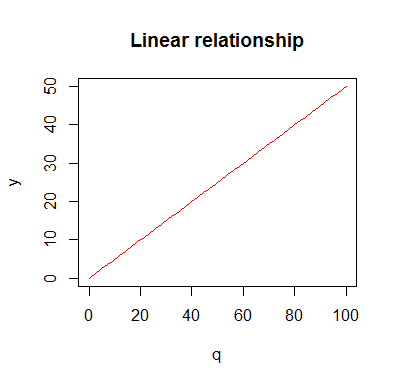
Linear Program Polynomial Interpolation Algorithm
A static function implementing the Linear Class for one off calculations Class LinearLinear interpolation is a process employed in mathematics, and numerous applications thereof including computer graphics. It is a very simple form of interpolation. In numerical analysis a linear interpolation of certain points that are in reality values of some function f is typically used to approximate the function f. Linear interpolation can be regarded as a trivial example of polynomial interpolation. The error of this approximation is defined as.
As you see, the approximation between two points on a given function gets worse with the second derivative of the function that is approximated. This is intuitively correct as well: the 'curvier' the function is, the worse is the approximations made with simple linear interpolation. Below you will find the interpolation graphs for a set of points obtained by evaluating the function, displayed in light blue, at particular abscissas. Route 66 Map Torrent.
The linear interpolating function, displayed in red, has been calculated using this class. In the first graph there had been chosen a number of 12 points, while in the second 36 points were considered. You may notice the root mean squared error in each of the cases. Pure Disco Vol 2 Rar Vietnam.
Dynamic Programming with Hermite Interpolation. The functional form V^ may be a linear combination of polynomials. Numerical Dynamic Programming.
Further information: The following table summarizes some classes of commonly encountered time complexities. In the table, poly( x) = x O(1), i.e., polynomial in x. Name Running time ( T( n)) Examples of running times Example algorithms constant time O(1) 10 Determining if an integer (represented in binary) is even or odd time O( α( n)) per operation using a time O( n) log-logarithmic O(log log n) Amortized time per operation using a bounded logarithmic time O(log n) log n, log( n 2) polylogarithmic time poly(log n) (log n) 2 fractional power O( n c) where 0 0 O(2 log n log log n) Assuming complexity theoretic conjectures, is contained in SUBEXP. Sub-exponential time (second definition) 2 o( n) 2 n 1/3 Best-known algorithm for and exponential time (with linear exponent) 2 O( n) 1.1 n, 10 n Solving the using exponential time 2 poly( n) 2 n, 2 n 2 Solving via factorial time O( n!) n!